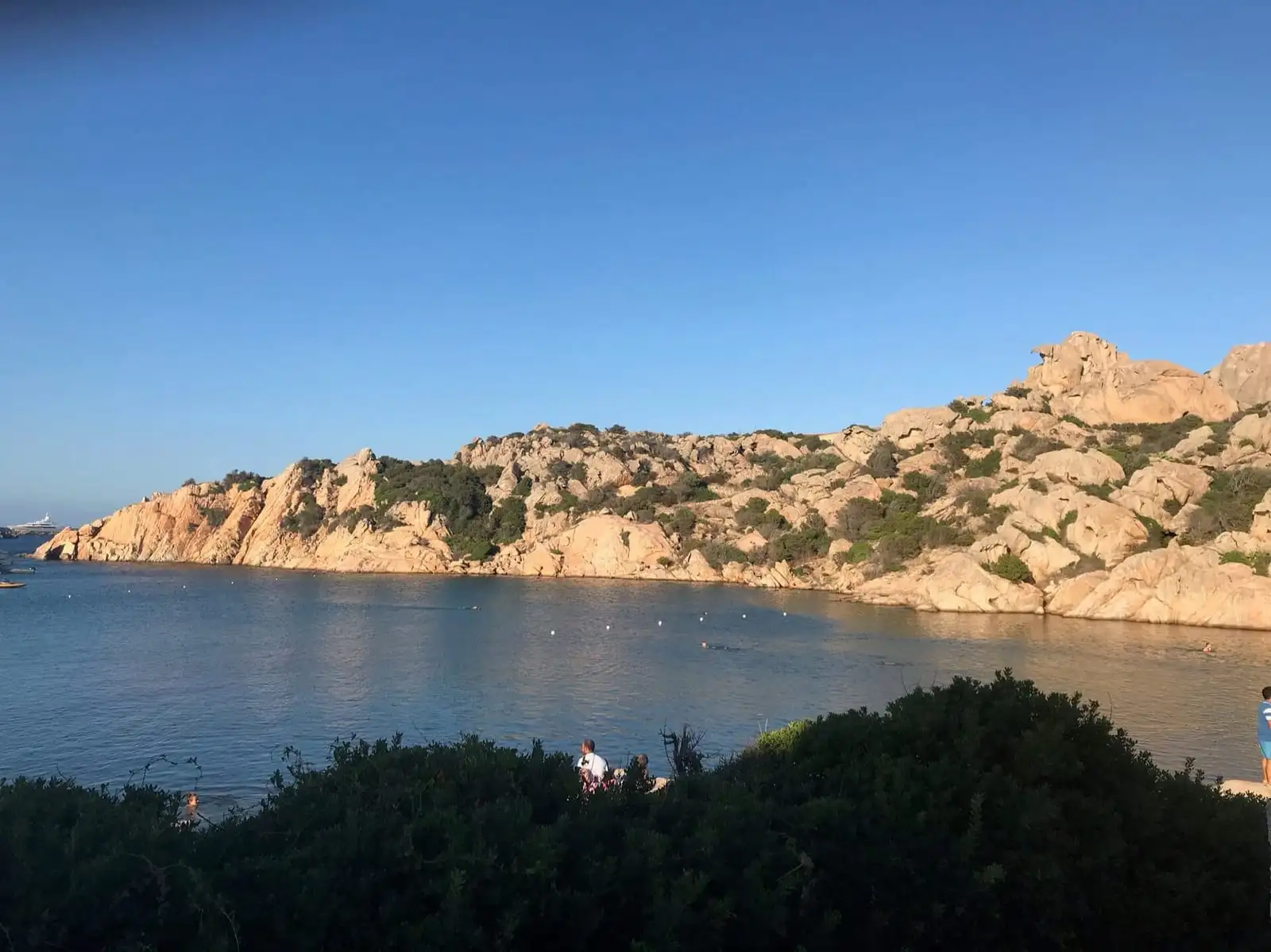
The La Maddalena beaches fall into two very different groups: those on the main island and on Caprera, where you arrive with a car brought over on the ferry from Palau, and those on the smaller islands, which you only ever see from the deck of a boat. Working out in advance which group your dream beach belongs to saves you a wasted day.
This guide runs through the La Maddalena beaches in Sardinia you can drive to, those on Caprera, and the coves that need a boat, with a table to compare them and the single most useful rule of all: choose your beach according to the wind.
La Maddalena beaches you can reach by car or bus
The main island has a panoramic ring road of about 20 km, the strada panoramica, running past all the principal beaches. With the car loaded onto a Delcomar or Maddalena Lines ferry at Palau, a crossing of 15 to 20 minutes with frequent sailings even overnight, the circuit fits comfortably into a day. By bike you will need legs, because the climbs over the granite come thick and fast. Our page on the panoramic ring road covers the route in detail.
Bassa Trinita
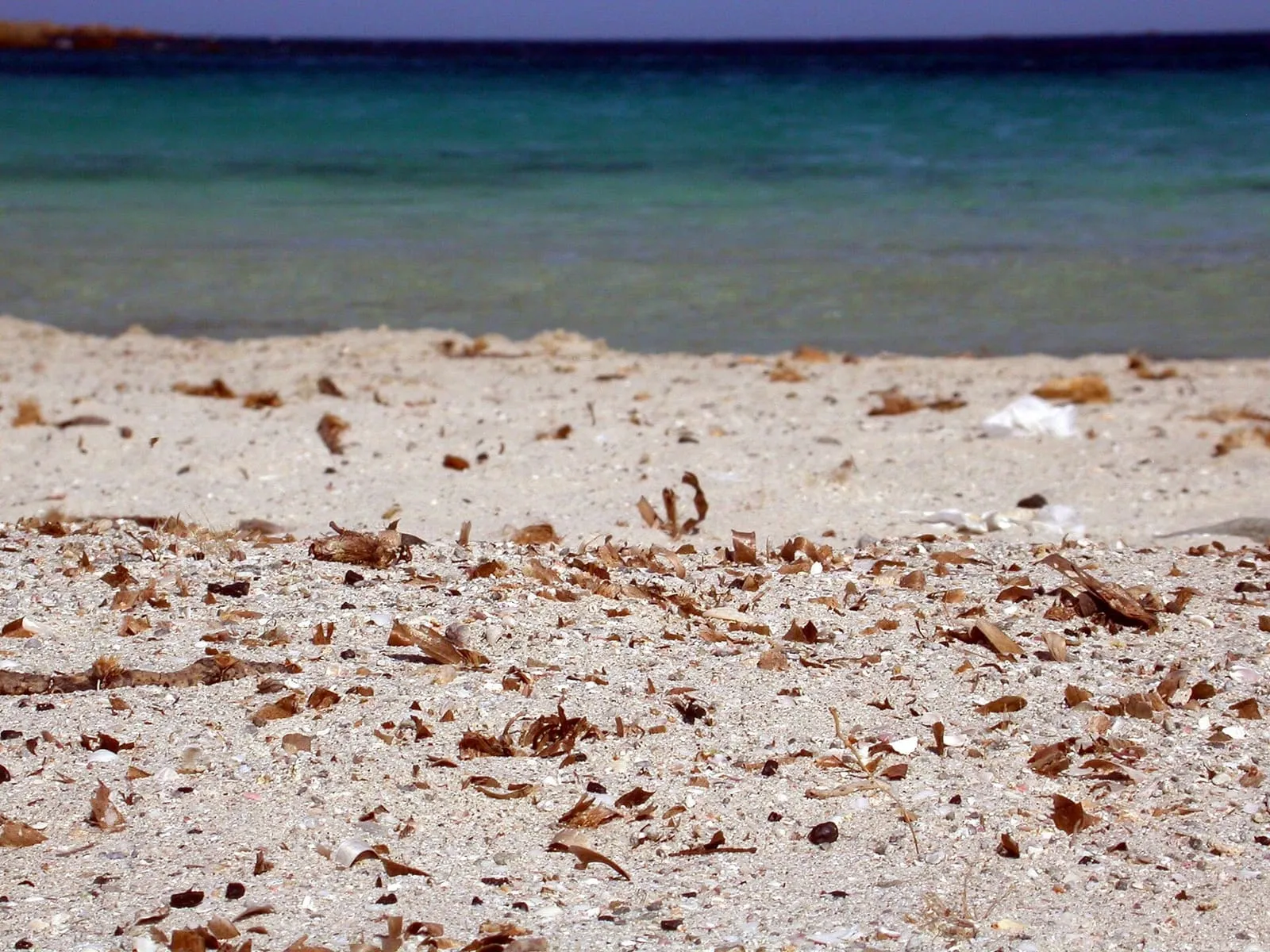
On the north-west coast, the best known beach on the island: coarse pale sand, water that shelves slowly, and dunes with scrub behind. You reach it from the ring road along a short unsurfaced stretch, then on foot. It is exposed to the mistral, and on a north-westerly the swell rolls in and the sand flies.
Monti d’Arena and Cala Lunga
Two neighbouring beaches on the north side. Monti d’Arena (also written Monte da Rena) is broad, with a sandy bottom and plenty of room; Cala Lunga is narrower and drawn out between rocks, with water that deepens quickly. Both take the mistral as badly as Bassa Trinita does.
Cala Spalmatore
On the eastern side, a deep bay protected by two headlands. This is the La Maddalena beach with the shallowest water and the calmest surface, the refuge on days with wind from the west. There is a serviced area in season and roadside parking that fills before 10 am in August.
Cala Francese
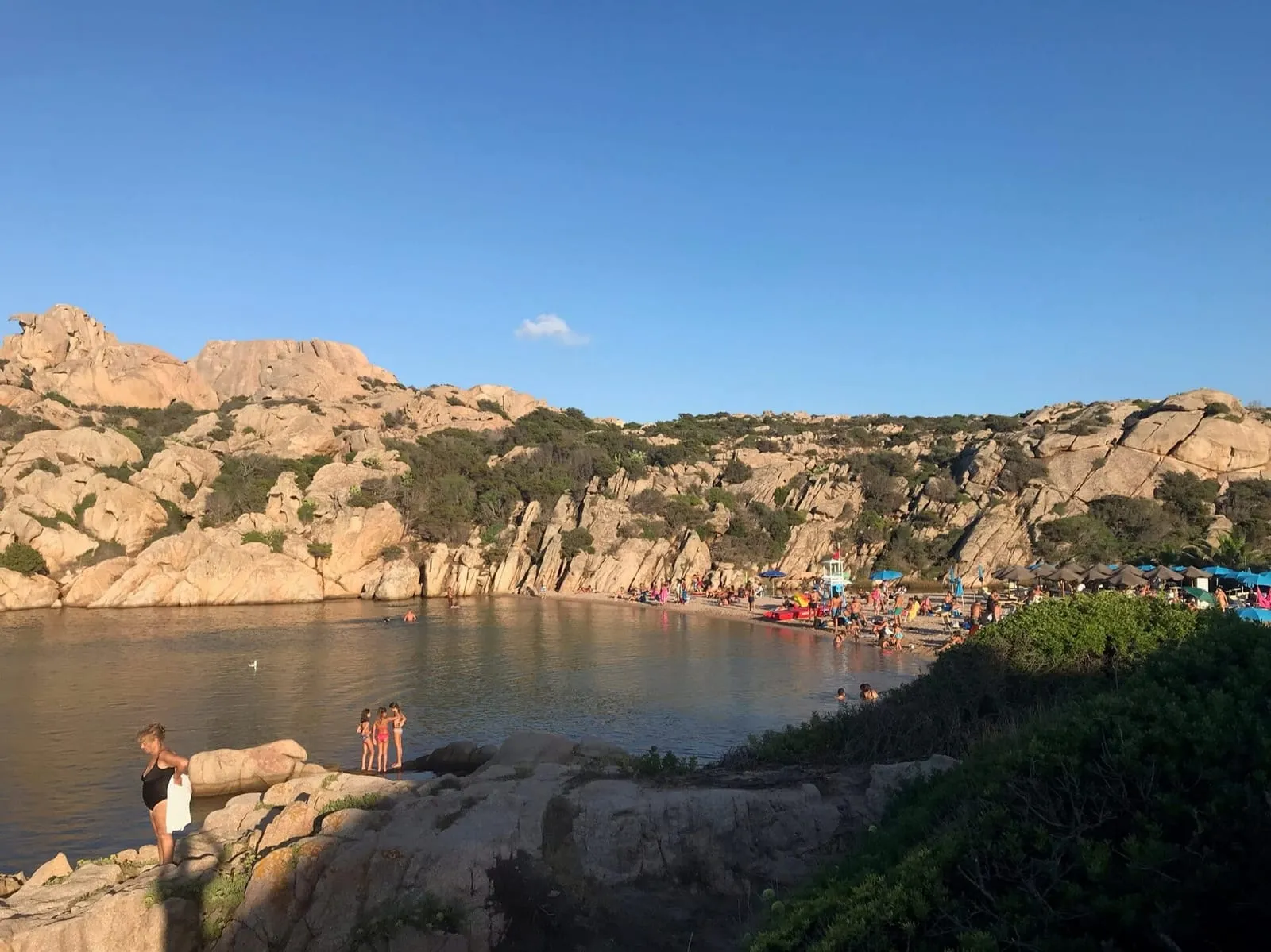
On the west coast, facing the old granite quarry. This is not a fine-sand beach: low rocks, small sandy pockets and flat slabs to lie on. It is exposed when the mistral gets up.
Punta Tegge, Nido d’Aquila and Testa di Polpo
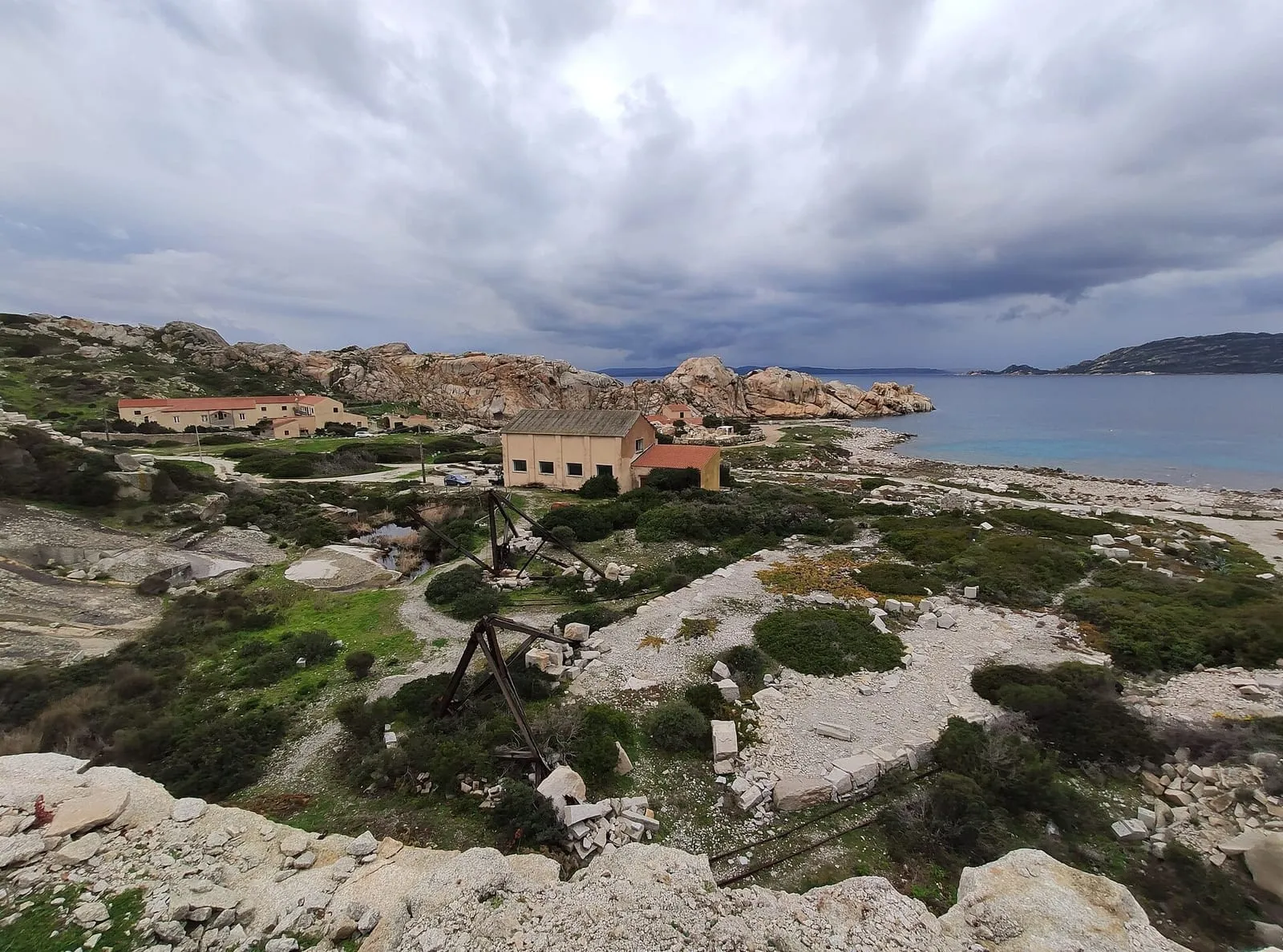
The three beaches on the south-west side, between the town and Cala Francese. Punta Tegge is a granite platform with the historic military battery behind it and small sandy inlets: convenient, close to the centre and made for a swim at sunset. Nido d’Aquila is the sandy cove nearest the town, shallow, with the old buildings as a backdrop. Testa di Polpo is small and sheltered, and often half empty even in high season.
Insider tip: if you come over on the ferry without a car, the local bus does serve the main beaches, but on a reduced timetable. Check the day’s departures at the stop by the harbour before you set off.
The beaches of Caprera
Caprera is joined to La Maddalena by the roughly 600 m bridge at Passo della Moneta, which you cross by car, by bike or on the bus. The island is nearly all pine wood and granite, with no housing beyond the Compendio Garibaldino and the sailing centre. Most of the beaches sit a short walk from car parks along the road. Paths and museums are covered on our Caprera page.
Cala Coticcio and the rule since 2021
The most photographed beach in the archipelago after Spiaggia Rosa, nicknamed Tahiti. Since summer 2021, according to the park, access on foot is allowed only with an authorised guide, subject to a daily quota and advance booking; the path runs about 3 km each way over rock, and closed shoes are compulsory. Boats may stop under park rules. Everything is on our Cala Coticcio page.
Cala Napoletana and Cala Brigantina
Two coves on the north-eastern side, reached on foot along the pine-wood paths. White sand, clear water over granite and few people, because the walk puts most visitors off.
Spiaggia del Relitto
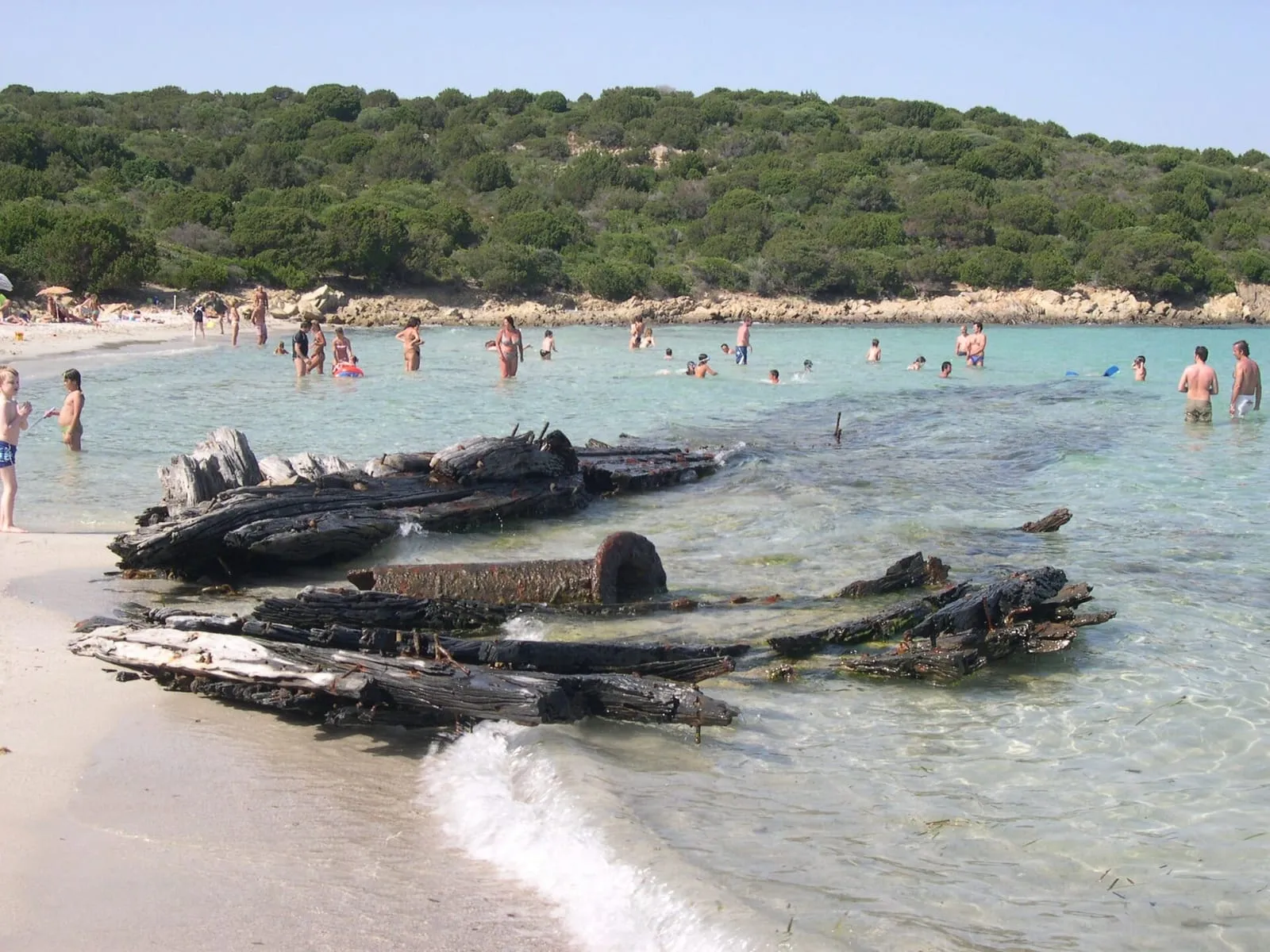
On the west side, facing La Maddalena, with a wooden boardwalk running down to the sand and the timbers of an old planked ship showing at the water’s edge. It is the easiest of the Caprera beaches to reach and the best for children: shallow water and an almost always calm sea, because the channel is sheltered.
Due Mari, Cala Portese and Cala Andreani
Spiaggia dei Due Mari sits on a tongue of sand with water on both sides, so you simply pick the sheltered flank. Cala Portese, on the south side, is a wide, shallow bay and one of the best choices in a northerly. Cala Andreani, to the south-west, is fine sand and granite, and usually quiet.
Beaches you can only reach by boat
No roads and no ferries come this way. The only options are an archipelago tour or a hire boat with a park permit. Classic tours make three or four stops in seven to eight hours, and the beaches below are precisely those stops.
- Cala Corsara, Spargi. Four small beaches in a row on the south side of the island, sculpted pink granite and a pale sandy bottom. The first stop of the day on nearly every trip from Palau. See our Spargi page.
- Spiaggia del Cavaliere, Budelli. On the north shore facing Santa Maria and Razzoli: brilliant white sand, shallow water. This is where the path to the viewpoint over Spiaggia Rosa begins, the beach itself having been closed since 1994. It is all in our guide to Spiaggia Rosa on Budelli.
- Cala Santa Maria. The archipelago’s long beach, white, with water that stays shallow for tens of metres. A relaxed stop with room for everyone, even in August. See our Santa Maria page.
- Porto della Madonna. Not a beach but a shallow basin between Budelli, Razzoli and Santa Maria, the natural pools. You swim straight off the boat, and it is often the longest pause of the day.
Of the tours that call there, the archipelago tour on a vintage motorboat makes 4 swim stops in 8 hours and is listed from €76 on GetYourGuide at the time of writing, rated 4.5 out of 5 from 215 reviews. The 4-stop tour from Palau takes in Spargi, Budelli, Santa Maria and La Maddalena on a large modern boat, 4.5 out of 5 from 2,330 reviews with the price on the listing. If you only have half a day, look at the small-group hybrid tour from La Maddalena, 4 to 5 hours covering Spargi, Cala Corsara and the photo stop at Spiaggia Rosa.
Table: every beach compared
| Beach | Island | Access | Facilities | Best for |
|---|---|---|---|---|
| Bassa Trinita | La Maddalena | Car, then a short walk | Few, seasonal | Sand and space, on days without mistral |
| Monti d’Arena | La Maddalena | Car | Few, seasonal | Families when the wind is southerly |
| Cala Lunga | La Maddalena | Car | None | Quiet |
| Cala Spalmatore | La Maddalena | Car, roadside parking | Serviced area in season | Children, mistral days |
| Cala Francese | La Maddalena | Car | None | Rocks, sunset, photography |
| Punta Tegge | La Maddalena | Car, close to town | Few, seasonal | An evening swim, snorkelling |
| Nido d’Aquila | La Maddalena | Car, or on foot from town | Few, seasonal | Anyone without a car |
| Testa di Polpo | La Maddalena | Car | None | Finding an empty cove |
| Cala Coticcio | Caprera | On foot with a guide (quota), or by boat | None | Snorkelling, photography |
| Cala Napoletana | Caprera | Path through the pine wood | None | Walkers |
| Cala Brigantina | Caprera | Path through the pine wood | None | Walkers |
| Spiaggia del Relitto | Caprera | Car and boardwalk | None | Children, calm water |
| Due Mari | Caprera | Car, then a short walk | None | Switching sides with the wind |
| Cala Portese | Caprera | Car, then a short walk | None | Mistral days |
| Cala Andreani | Caprera | Car, then a short walk | None | Quiet |
| Cala Corsara | Spargi | Boat only | None | Snorkelling, granite |
| Spiaggia del Cavaliere | Budelli | Boat only | None | The viewpoint over Spiaggia Rosa |
| Cala Santa Maria | Santa Maria | Boat only | None | Shallow water, lazing about |
| Porto della Madonna | Between Budelli, Razzoli and Santa Maria | Boat only, off the ladder | None | The best swim of the trip |
Facilities change from year to year with the municipal concessions: read that column as an indication rather than a guarantee, and confirm locally.
Choosing a beach by the wind
In the archipelago the wind shapes the day more than the temperature does. The mistral blows from the north-west, is frequent in spring and autumn, and can arrive on any summer day. When it does, north- and west-facing beaches turn into a wall of waves and flying sand, while those looking south and east stay calm.
- In a mistral: Cala Spalmatore on La Maddalena; Cala Portese, Cala Coticcio by boat, and the sheltered flank of Due Mari on Caprera. Boat trips are often cancelled, with a refund or a new date according to the GetYourGuide listings.
- In a sirocco or a south-easterly: Bassa Trinita, Monti d’Arena, Cala Francese, Punta Tegge.
- In flat calm: anywhere. That is the day for the full tour, because the skipper can reach Razzoli and the exposed coves too.
Insider tip: check the wind forecast the evening before, not on the morning itself. If a mistral above 20 knots is on the way, book the boat trip for another day and save Spalmatore and Portese for the windy one. The photographs come out better anyway, because the air is so clear.
Rules and things worth knowing
The whole archipelago is the Parco Nazionale dell’Arcipelago di La Maddalena. According to the park, taking away sand, shells or pebbles is prohibited in any quantity: checks are carried out at the harbours and the material is confiscated along with a fine. Fires and camping are not allowed on the smaller islands, and drones need authorisation. Anyone arriving in their own boat or a hire boat needs the park’s navigation permit and cannot anchor over Posidonia; buoys are laid in the main coves. Our summary of zones and permits sits on the national park page.
On the smaller islands you will not find a bar, a toilet or a sunlounger. The boat is your base: water, food, shade and facilities are all on board, and on the motor ships a pasta lunch is often included.
What to pack: reef-safe sunscreen, a hat, a towel, water shoes for granite and sea urchins, mask and snorkel (not always supplied on tours), a dry bag, cash for any landing contribution collected at check-in, and a light top for the ride home.
Insider tip: on La Maddalena the August problem is not finding a space on the sand, it is finding a space for the car. By 9:30 am the car parks at Spalmatore and Bassa Trinita are full. Either take the first useful ferry, or do the opposite of everyone else: the boat beaches in the morning, then Spalmatore at 5 pm as the sand commuters head home.
The short version
The La Maddalena beaches you can drive to would keep you busy for a week, but the most photographed half of the archipelago, from Cala Corsara to the natural pools, is visible only from a boat. The simplest way to combine the two is to set aside one day for the full tour and spend the others at Spalmatore, Bassa Trinita and the coves of Caprera. For the trip with four swim stops and a view of Spiaggia Rosa, check availability and prices on GetYourGuide; for the individual islands, start with our overview of the archipelago islands and the page on La Maddalena.
Pros
- With a car on the ferry you can change beach two or three times a day
- The coves on the smaller islands come with a 7–8 hour tour and three or four swims
- Pale sand and granite seabeds make snorkelling easy, children included
Cons
- The smaller islands have no facilities at all: no shade, no bar, no toilets
- Beach car parks on La Maddalena fill by mid-morning in August
- The mistral writes off half the island and cancels the boat trips
- Cala Coticcio on foot requires a guide and a place in the daily quota
Checked on the ground
Details we verified in person or against official sources.
- The strada panoramica on La Maddalena, about 20 km, passes every beach reachable by car
- Caprera is reached by car, bike or bus across the Passo della Moneta bridge
- Tour 485895 includes 4 swim stops and is listed from €76 on GetYourGuide in September 2026
- Taking sand is prohibited and penalised throughout the archipelago, according to the park
Tours we recommend for this page
Ratings and prices as published on GetYourGuide when we last checked.
-
Departure: La Maddalena / Palau
From La Maddalena or Palau: Archipelago Boat Tour
Check dates & prices -
Departure: Palau
Palau: La Maddalena Archipelago Boat Tour with 4 Stops
Check dates & prices -
Departure: La Maddalena
La Maddalena: Small-Group Hybrid Boat Tour with Aperitif
Check dates & prices
Frequently asked questions
Which is the best beach in La Maddalena?
On the main island, Bassa Trinita and Cala Spalmatore are the most photographed. On Caprera it is Cala Coticcio, though reaching it on foot needs a guide. By boat, Cala Corsara on Spargi.
Can you drive to the beaches on La Maddalena?
Yes, to those on the main island and on Caprera. Put the car on the ferry from Palau (Delcomar or Maddalena Lines, 15–20 minutes) and follow the panoramic ring road.
Which beaches can only be seen by boat?
Cala Corsara on Spargi, Spiaggia del Cavaliere on Budelli, Cala Santa Maria and the natural pools of Porto della Madonna. Spiaggia Rosa can only be viewed from the water.
Are there any beach clubs?
A few, seasonal, and only on some La Maddalena beaches. On Caprera and the smaller islands bring everything with you, water included.
Where should you go when the mistral blows?
To south- and east-facing beaches sheltered from the north-westerly: Cala Spalmatore on La Maddalena, Cala Portese and Cala Coticcio on Caprera. Boat trips are often cancelled.
Can I take a little sand home as a souvenir?
No. According to the Parco Nazionale dell'Arcipelago di La Maddalena, taking sand, shells or pebbles is prohibited and penalised, with the material confiscated.
When is the water warmest?
In August, around 25–26 °C. June sits at about 20–21 °C, and late September at 22–23 °C.